
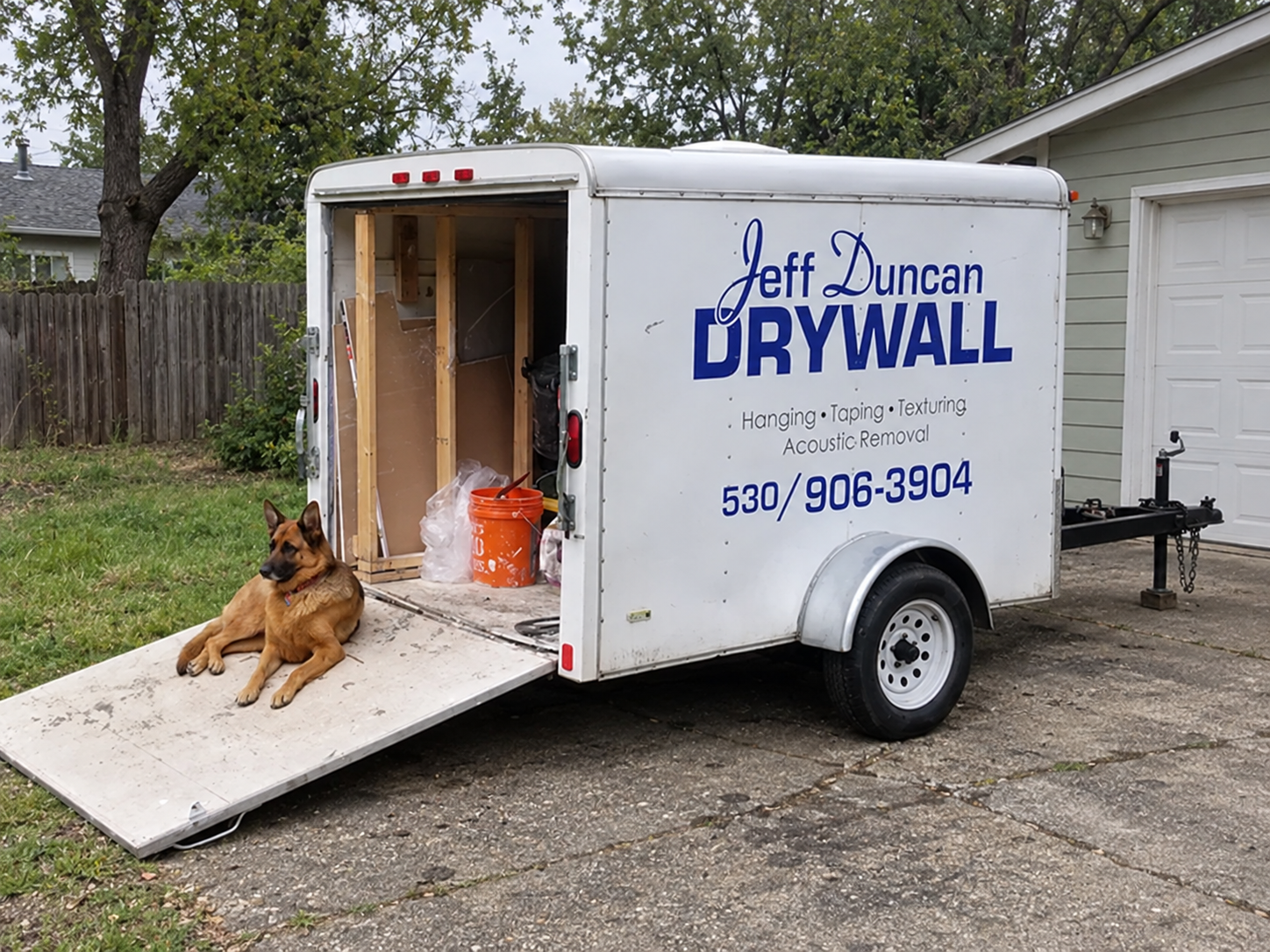
Drywall Texture Matching & Application in Nevada & Placer County
Knockdown, orange peel, skip trowel, hand texture, and smooth wall. Matching an existing texture on a repair or remodel is the hardest part of the trade, and Jeff Duncan approaches it with patience and decades of foothill experience.
In the drywall trade, applying a uniform texture across an empty, newly built home is straightforward production work. But walking into an occupied foothill home where a wall has been opened for plumbing, an electrical panel relocated, or an addition tied into an existing room, and blending the new patch so that nobody can tell where the work occurred—that is where craftsmanship is tested. Matching an existing texture on a repair is the hardest part of the trade, and there are no shortcuts.
Why Texture Matching Is the Hardest Part of the Trade
When a drywall contractor repairs a section of wall or ceiling, the new patch cannot simply be sprayed with a standard can of aerosol texture from a hardware store. Spray cans deposit inconsistent droplet sizes with unpredictable propellant pressure, leaving a telltale ring or stippled mound that stands out like a sore thumb as soon as fresh paint is applied.
The original texture was applied years or decades ago using commercial spray rigs or hand trowels at a particular air pressure, nozzle diameter, and compound viscosity. Over the ensuing years, multiple coats of paint have filled in the micro-crevices and softened the edges of the original texture droplets. A successful patch requires testing compound viscosity, feathering the repair boundary out across several feet, matching the original droplet profile, and softening the new edges with a damp sponge so the transition disappears.
Orange Peel Texture
Orange peel is one of the most widely used textures in California residential construction. It receives its name from its subtle, dimpled appearance resembling citrus skin. To apply orange peel, compound is mixed to a smooth batter-like consistency and atomized through a spray gun using compressed air.
Orange peel textures range from fine to heavy depending on the nozzle tip and air pressure. Because orange peel droplets are not flattened after spraying, dialing in the exact air-to-mud ratio is critical to preventing runs or irregular splatter clumping.
Knockdown Texture
Knockdown is a popular foothill texture offering greater visual depth and acoustic softening than light orange peel. The process begins similarly to orange peel but utilizes a heavier droplet spray or splatter application.
The critical moment in knockdown application is timing. The wet droplets must be allowed to set up on the wall until a slight surface skin forms, usually between 5 to 15 minutes depending on ambient humidity and room temperature. Once set, a flexible rubber, Lexan, or spring-steel knockdown knife is drawn across the surface at a shallow angle. This flattens the tops of the mud droplets into smooth plateaus while leaving the valleys untouched, producing a rich Spanish or Mediterranean look. Knocking down too early smears the pattern; knocking down too late tears the drying mud.
Skip Trowel and Hand Textures
Throughout Nevada County, Placer County, and the Gold Country, custom homes frequently showcase skip trowel, Tuscan, or hand-troweled finishes. These textures do not rely on spray equipment. Instead, compound is applied by hand using a curved steel pool trowel or hawk.
The tradesman holds the trowel at a specific angle and sweeps across the wall in overlapping arcs, allowing the compound to skip across the surface in organic, random patterns. Replicating another artisan’s skip trowel rhythm on a remodel or patch requires acute visual observation and steady hand control to match the arc radius, thickness, and skip density.
Smooth Wall Finishing
For homeowners seeking a clean, contemporary architectural look, smooth wall is the ultimate finish. Smooth wall offers no texture to hide underlying framing flaws or compound transitions. Creating a true smooth wall requires bringing the entire surface to a Level 4 or Level 5 finish, followed by rigorous hand-sanding under 500-watt halogen or LED work lights. When painted, a proper smooth wall delivers crisp, museum-grade elegance.
Acoustic / Popcorn Ceiling Removal
Many older foothill homes were finished with acoustic “popcorn” ceiling texture. Common in its era, that heavy stippled ceiling dates an interior, gathers dust and cobwebs that are hard to clean, and reads as a leftover from another decade. Jeff takes the existing acoustic texture down and re-finishes the ceiling — either smooth or with a fresh, lighter texture such as orange peel or knockdown — so the ceiling reads clean and current.
Because acoustic removal is a re-finishing job at its core, it sits naturally alongside texture work: the ceiling has to be brought back to a flat, paintable surface and finished to the level the room calls for. Call to discuss the room, the existing ceiling, and the finish you want, and Jeff will talk through what is involved straight and plain.
Frequently Asked Questions: Texture Matching & Application
Why is matching an existing wall texture so difficult?
Matching an existing texture is the most difficult challenge in the trade because no two original drywallers sprayed at the same air pressure, orifice size, mud consistency, or knockdown timing. Furthermore, existing walls have accumulated multiple coats of primer and paint over years or decades, which softens droplet edges. Blending a fresh repair requires replicating both the spray droplet density and the softening of paint buildup.
What is the difference between orange peel and knockdown texture?
Orange peel consists of fine, uniform spatter droplets sprayed onto the wall and left untouched to dry, resulting in a dimpled surface reminiscent of citrus skin. Knockdown starts with larger mud spatter that is allowed to set for several minutes until the skin forms, after which a flat trowel or Lexan blade is lightly dragged across the surface to flatten the tops of the mud peaks.
Can you match skip trowel and custom hand textures in older foothill homes?
Yes. Many custom foothill homes in Grass Valley, Nevada City, and Auburn feature hand-troweled skip trowel, Santa Fe, or Mediterranean textures. These are applied manually with a curved curved-edge trowel or hawk-and-trowel technique, requiring an intuitive feel for compound thickness and wrist angle.
Can textured walls be converted to smooth wall?
Yes. Converting existing textured walls to a modern smooth-wall finish requires skimming the entire surface with multiple tight coats of compound, sanding between coats, and applying a Level 5 finish. It is a labor-intensive process that completely transforms an interior.
Do you remove acoustic popcorn ceilings?
Yes. Jeff removes dated acoustic popcorn ceiling texture and re-finishes the ceiling smooth or with a new texture such as orange peel or knockdown. It is a re-finishing job at heart — the ceiling is brought back to a flat, paintable surface and finished to suit the room. Call to talk through the room and the finish you have in mind.
Have a texture matching or application question?
Call Jeff Duncan directly to discuss your wall textures or send photos.
Service Area Map — Sierra Foothills
Request a Quote
Tell me about the job and I'll get back to you.