
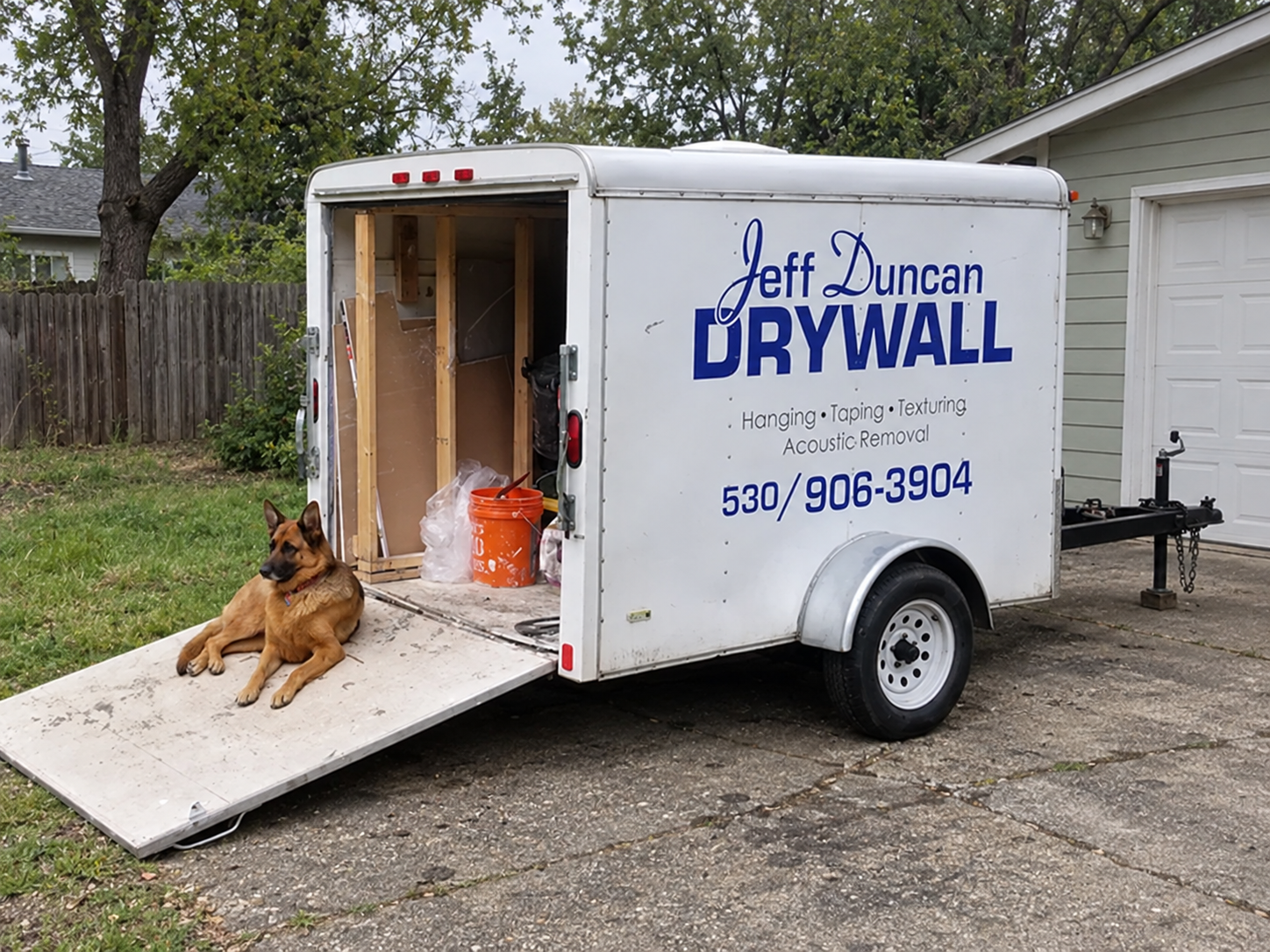
Drywall Repair & Patching in Grass Valley & Nevada County, CA
Settling cracks, doorknob holes, water leak damage, plumbing access cutouts, and corner bead impacts repaired cleanly and textured to disappear completely.
Every homeowner eventually faces drywall damage. Whether it is an old roof leak that stained and softened a living room ceiling, an electrician who had to open chases to run new wiring, or persistent settling cracks tracing over door headers, a bad patch can ruin the look of an entire room. Jeff Duncan has specialized in foothill drywall repairs since 1995, restoring damaged surfaces so thoroughly that the original opening cannot be found.
Settling and Seasonal Movement in Foothill Homes
The Sierra foothills present unique geological and atmospheric challenges for residential structures. Soils across Nevada, Placer, Yuba, and El Dorado counties frequently consist of heavy clay that expands significantly during saturated winter months and contracts dramatically during dry, hot summers. In addition, many homes are built on sloped lots with step-down foundations or pole-and-post subfloors.
As foundations experience subtle seasonal shifting and large roof trusses undergo thermal expansion, drywall is subjected to shear stress. This movement concentrates at the weakest structural points—typically the upper corners of door frames, window openings, and the intersections where vaulted ceilings meet vertical walls. Simply applying standard premixed spackle over a settling crack does nothing; the first shift in seasonal humidity will reopen the hairline fracture.
Jeff repairs structural settling cracks by V-notching the damaged joint with a utility blade to clear crushed gypsum, screwing the loose drywall securely back into the framing, and applying setting-type chemical compound (hot mud) reinforced with high-strength tape. Setting compound cures by chemical crystallization rather than water evaporation, providing exceptional tensile strength that resists future movement.
Ceiling Repairs and Sagging Board
Gravity makes ceiling repair substantially more demanding than wall patching. A failed roof flashing or upstairs plumbing leak can saturate ceiling drywall, causing the gypsum core to disintegrate and the board to pull away from screw heads.
Jeff cuts back water-damaged ceiling drywall until sound, dry framing is reached. Perimeter solid wood blocking is screwed into place between joists so that every edge of the replacement sheet has solid, immobile backing. The new drywall is screwed tight, seams are taped with setting compound, and the patch is feathered out over two feet in all directions so the joint creates no visible hump under ceiling lighting.
Holes, Impact Damage, and Utility Openings
Plumbing repairs, repipes, HVAC duct rerouting, and door impacts frequently leave rectangular or irregular voids in finished walls. For smaller holes, a traditional "California patch" (or blowout patch) can be employed, where drywall is cut with an intact paper border that acts as its own tape.
For larger utility openings, new drywall of matching thickness (1/2-inch or 5/8-inch) is cut and fitted tightly into the opening, secured to wooden backing, and finished with multiple tight coats of compound.
Nail Pops and Crushed Corner Bead
In newer homes and additions, lumber drying often causes framing studs to shrink away from the back of the drywall. As the board flexes, fasteners pop through the paper face, leaving small circular blisters in the paint. Repairing a nail pop involves driving new drywall screws 1.5 inches above and below the failed fastener into solid lumber, removing or resetting the original nail, and re-mudding the area.
Crushed corner beads from moving furniture or pet damage are cut back cleanly, straightened or replaced with fresh galvanized bead, nailed or crimped tight, and feathered into the existing wall plane.
Blending the Patch into Existing Texture
The final and most critical step of any repair is blending. Once the compound is flat, Jeff feathers the boundary with fine sandpaper and a damp sponge to eliminate sharp ridge lines. The texture is then mixed to match the surrounding orange peel, knockdown, or skip trowel profile, sprayed or troweled on, and feathered out into the painted wall. When primed and painted, the patch disappears completely.
Frequently Asked Questions: Drywall Repair & Patching
Why do foothill homes experience frequent drywall settling cracks?
Sierra foothill properties commonly sit on expansive clay soils or hillside slopes subjected to extreme seasonal moisture swings—from parched, hot summers to heavy winter rains and snowmelt. As the soil shifts and roof trusses experience thermal expansion, framing moves slightly, causing stress cracks over doors, windows, and vaulted ceiling joints.
How do you permanently repair a reoccurring settling crack?
Simply putting compound over a settling crack ensures it will reappear within months. Permanent repair requires V-notching the crack to remove loose gypsum, securing adjacent studs with fresh drywall screws, installing high-tensile fiberglass or paper tape with setting-type compound (hot mud), and feathering wide before applying matching texture.
How are ceiling patches supported and repaired safely?
Ceiling repairs require squaring off the damaged opening to the center of adjacent joists or installing solid wood backer blocking. The replacement board is screwed securely to backing, taped with mesh or paper tape embedded in high-strength compound, and feathered out up to 24 inches to eliminate ceiling humps.
Can a drywall patch be made completely invisible?
Yes, when executed correctly. An invisible patch requires three things: structural stability so the seam doesn't move, wide feathering so the compound has an imperceptible slope, and precise texture matching that blends seamlessly into the surrounding painted surface.
Have a hole, crack, or leak damage that needs fixing?
Call Jeff Duncan directly to discuss the repair or send photos.
Service Area Map — Sierra Foothills
Request a Quote
Tell me about the job and I'll get back to you.