
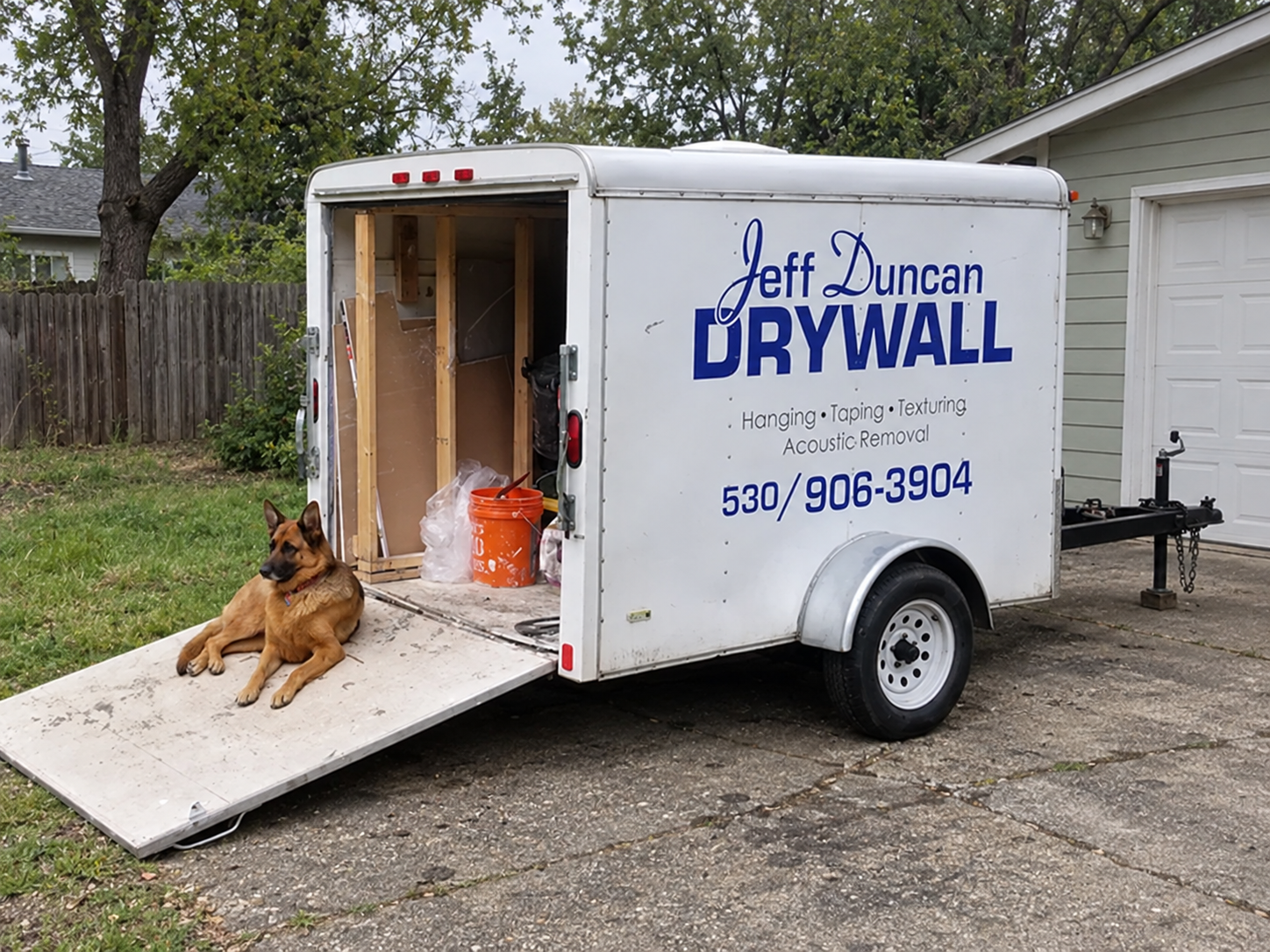
Drywall Craft in the Sierra Foothills Since 1995
Skilled finish-trade drywall work for custom homes, rural additions, remodels, and historic Gold Country renovations across Nevada, Placer, Yuba, and El Dorado counties.
Jeff Duncan has been hanging and finishing drywall in the Sierra foothills since 1995. Working in this region for three decades means understanding the physical realities of Gold Country construction: homes built on granite outcroppings, expansive clay hillsides, and steep parcels where structural framing endures continuous seasonal movement between summer heat and winter rains.
Foothill Construction Realities
Foothill construction differs fundamentally from suburban tract developments in the Central Valley. Many foothill homes sit on acreage lots or winding ridge roads in Nevada City, Rough and Ready, Auburn, and Cool. These properties feature custom architectural geometry—cathedral ceilings, exposed heavy timber rafters, scissor trusses, clerestory windows, and step-down floor plans designed to follow natural hillside grade.
When roof trusses span forty or fifty feet under heavy winter snow loads and then dry out under dry summer heat, the lumber expands and contracts. If drywall sheets are fastened without accounting for truss uplift or structural deflection, corner joints tear and ceiling fasteners pop. Knowing where to use floating corner clips, where to omit perimeter screws, and how to bed high-tensile paper tape with setting-type compounds ensures that finished surfaces remain intact through years of regional temperature swings.
Older Gold Country Housing Stock and Additions
A substantial portion of drywall work in Nevada and Placer counties involves older homes—structures originally framed with rough-sawn dimensional lumber, old lath and plaster walls, or piecemeal remodels completed decades ago. Tying new drywall into true 2x4 framing from the mid-twentieth century requires patience, shimming, and an eye for transitional planes.
In addition to older homes, garage conversions and detached accessory dwelling units (ADUs) have become common across foothill properties. Converting a garage or unfinished shop space into habitable living quarters requires installing 5/8-inch Type X fire-rated assemblies along separation walls, boxing out structural posts, hanging around ductless mini-split penetrations, and creating smooth transitions between concrete stem walls and wood-framed partitions.
What a Level-5 Finish Actually Means
In the modern architectural vernacular of foothill custom builds, large glass walls and open floor plans are standard. However, those architectural elements create challenging conditions for drywall: severe raking daylight. When low morning or late afternoon sun floods across an interior wall, standard residential finishes often show joint banding or paper variation.
A Level-5 finish is the highest recognized standard in the gypsum trade. It requires embedding tape and applying two finish coats over all flat joints and fasteners—just like a standard Level-4 finish—followed by a continuous, paper-thin skim coat of compound applied across 100% of the gypsum face paper. This skim coat equalizes surface suction and texture across the entire wall plane so that primer and low-sheen paint absorb with absolute uniformity. When executed properly, a Level-5 wall reveals no seams, no fastener halos, and no surface discrepancies under severe natural light.
Owner-Operator Accountability
Drywall is a trade where accountability matters at every stage. A hanging flaw becomes a taper’s headache, and a taping defect becomes a painter’s nightmare. Because Jeff Duncan operates as a dedicated finish-trade contractor, there is no hand-off between disconnected crews. Every stud is checked before board goes up, every corner bead is set straight to line, and every seam is coated and inspected personally.
Planning a Project in the Foothills?
Call Jeff Duncan directly to discuss your drywall hanging, taping, or repair needs.